Youth entrepreneurs, industry experts and stakeholders came together to examine what holds young people back and chart a more practical path towards participation in horticulture.
Ghana’s horticulture sector holds considerable promise for entrepreneurship, employment and economic growth. Yet, for many young people, turning that promise into a viable business or sustainable career remains an uphill task.
The familiar explanations often point to limited access to finance, land or technical skills. But how well do we understand the underlying causes of these barriers? And perhaps more importantly, are the people most affected being sufficiently involved in shaping the solutions?
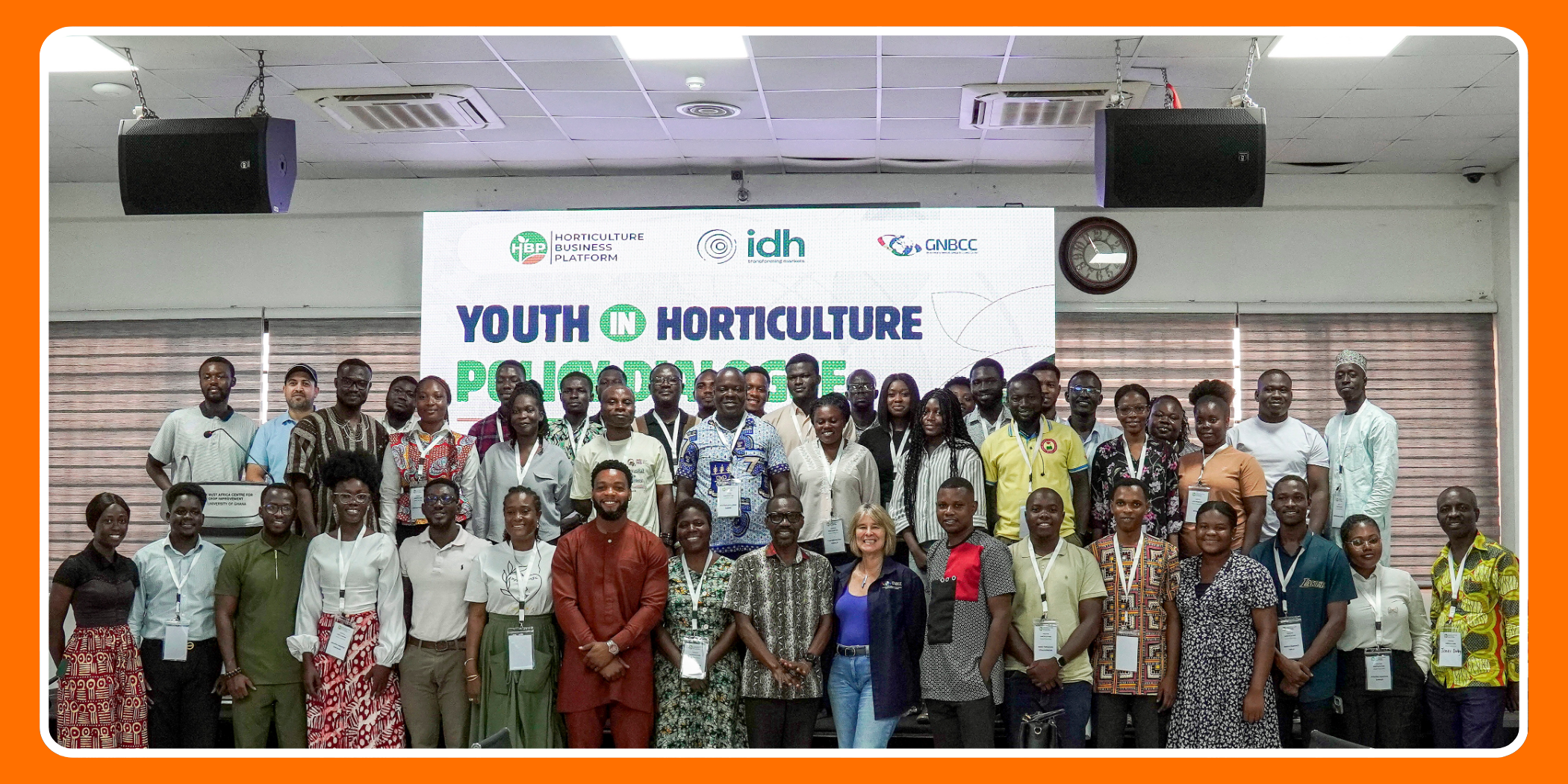
These questions set the stage for the Youth in Horticulture Policy Dialogue, convened by the Horticulture Business Platform (HBP), in collaboration with IDH and the Ghana Netherlands Business & Culture Council (GNBCC), on Friday, 23 October 2026, at the WACCI Main Auditorium, University of Ghana.
The dialogue brought together young agripreneurs, horticulture enthusiasts, industry experts and other stakeholders for a purposeful conversation aimed at moving beyond general assumptions, identifying the root causes of limited youth participation and developing practical recommendations to address them.
Importantly, the objective was not simply to identify what is wrong. It was to explore what can be done, who should take responsibility and how the proposed solutions could inform policy and programme design.
Opening the dialogue, HBP Project Manager Benjamin Agamah welcomed participants and outlined the rationale for convening the engagement, underscoring the importance of bringing diverse perspectives together to better understand the realities confronting young people in horticulture.
In her partner remarks, Hilde Famaey, General Manager of GNBCC, highlighted horticulture's potential as a pathway to enterprise development and employment, particularly for young people seeking meaningful economic opportunities.
She emphasized GNBCC's commitment to private-sector development through business support, market connections and strategic partnerships. Drawing attention to complementary initiatives such as HBP, the Horticulture Business Challenge (HBC) and the SME Desk, she reinforced the importance of ensuring that young entrepreneurs receive not only technical knowledge but also the business capabilities, networks and opportunities needed to succeed.
At the heart of her message was the need to listen more closely to entrepreneurs, understand the practical challenges they encounter and translate those experiences into meaningful institutional support and policy recommendations.
She left participants with a memorable charge:
Speaking on behalf of IDH Ghana, Akua Benewaa Okrah, Innovation Manager, expressed appreciation for the collaboration with HBP and its commitment to ensuring that young people, particularly women, have a voice in discussions and decisions that influence their participation in the sector.
She encouraged participants to engage openly, share their experiences and contribute meaningfully to the discussions, expressing optimism about the recommendations that would emerge from the engagement.
Providing a technical foundation for the dialogue, Professor Naalamle Amissah of the University of Ghana presented an overview of youth participation in the horticulture sector, informed by a pre-event survey of horticulture experts and stakeholders.
The survey captured perspectives from respondents across 13 of Ghana's 16 regions, providing an indicative picture of the challenges associated with youth participation.

Professor Amissah was careful to clarify that the findings did not constitute a nationally representative study. Rather, they offered an evidence-informed starting point for deeper discussion and collective examination of the issues.
Among the barriers identified were difficulties accessing finance and agricultural land, both of which continue to feature prominently in conversations about agricultural entrepreneurship.
However, the survey also brought attention to a less frequently examined challenge: the gap between opportunities available in the sector and the information reaching young people who could benefit from them.
This raised an important dimension of the conversation. Creating opportunities is one thing. Ensuring that young people know about them, can access them, and are adequately supported to take advantage of them is another.
Building on the survey findings, participants moved into facilitated breakout discussions designed to examine the barriers in greater depth.
The conversations focused on seven interconnected challenges: limited access to finance and credit; limited access to markets and buyers; inadequate technical knowledge and practical skills; complex regulatory requirements and certification processes; limited access to agricultural land; inadequate entrepreneurship and business development support; and limited access to quality inputs, infrastructure and other essential services.
Rather than treating these challenges as isolated problems, participants were encouraged to examine the factors sustaining them and consider how different constraints might reinforce one another.


Each group was tasked with diagnosing its assigned barriers, identifying underlying causes, proposing practical solutions and considering the institutions best positioned to champion the recommendations.
Crucially, the discussions also explored implementation and accountability arrangements, reflecting the understanding that recommendations are only as useful as the mechanisms established to advance them.
The groups subsequently presented their findings during a plenary session, allowing participants to interrogate ideas, contribute additional perspectives and identify areas of convergence.
The rapporteurs consolidated the discussions, bringing together the different viewpoints into a common body of findings and proposed recommendations for further consideration.
This process helped move the conversation from a broad acknowledgement of challenges towards a more structured examination of possible responses and institutional responsibilities.
While the technical presentation and breakout discussions provided an important analytical foundation, one of the most valuable dimensions of the dialogue came from the people already navigating the sector.
In a session facilitated by Professor Freda E. Asem of the University of Ghana, six young entrepreneurs took participants through their respective business journeys, sharing their innovations, achievements and challenges.


Their accounts offered an opportunity to understand youth participation from a different perspective: not simply through surveys or institutional assessments, but through the lived experiences of entrepreneurs building businesses within Ghana's horticulture value chain.
The stories of innovation and progress demonstrated the opportunities that exist for young people in the sector. Equally important were the accounts of obstacles encountered along the way, providing practical context for the issues discussed earlier in the day.
These experiences reinforced why young entrepreneurs must be active contributors to discussions about the future of horticulture, rather than merely being the intended beneficiaries of decisions made on their behalf.
The session also created space for questions and exchanges, connecting individual enterprise experiences with the broader policy and institutional challenges under consideration.
The final stages of the dialogue focused on consolidating and validating the recommendations emerging from the day's engagement.
Following presentations by the rapporteurs, participants reviewed the proposed recommendations, offered further input and worked towards consensus. Facilitated by Professor Freda Asem, the process also considered the institutions that could champion the recommendations and the accountability arrangements needed to support implementation.
The aim was to establish a practical foundation for further policy engagement and programme interventions to improve youth participation in horticulture.
In his closing remarks, HBP Project Manager Benjamin Agamah reaffirmed the Platform's commitment to following through on the dialogue's outcomes and working with identified institutions to advance the recommendations in relevant policy discussions and future programme design.
As a sector coordination, representation and advocacy platform, HBP will continue connecting the experiences of horticulture value chain actors with institutions capable of influencing change.
HBP extends its sincere appreciation to Professors Naalamle Amissah and Freda E. Asem of the University of Ghana for their technical leadership, and to GNBCC and IDH for their collaboration and support.
Special appreciation also goes to the young entrepreneurs, industry experts, horticulture enthusiasts and stakeholders whose contributions gave the dialogue its substance and purpose.
The success of the dialogue will ultimately be measured by what its conversations help to change. The conversation has begun. The responsibility now is to turn it into action.


Cross-published with permission as part of the GNBCC & HBP Bilateral Agribusiness Integration.
Receive our monthly digests featuring member profiles, sector reports, and practical farming techniques.